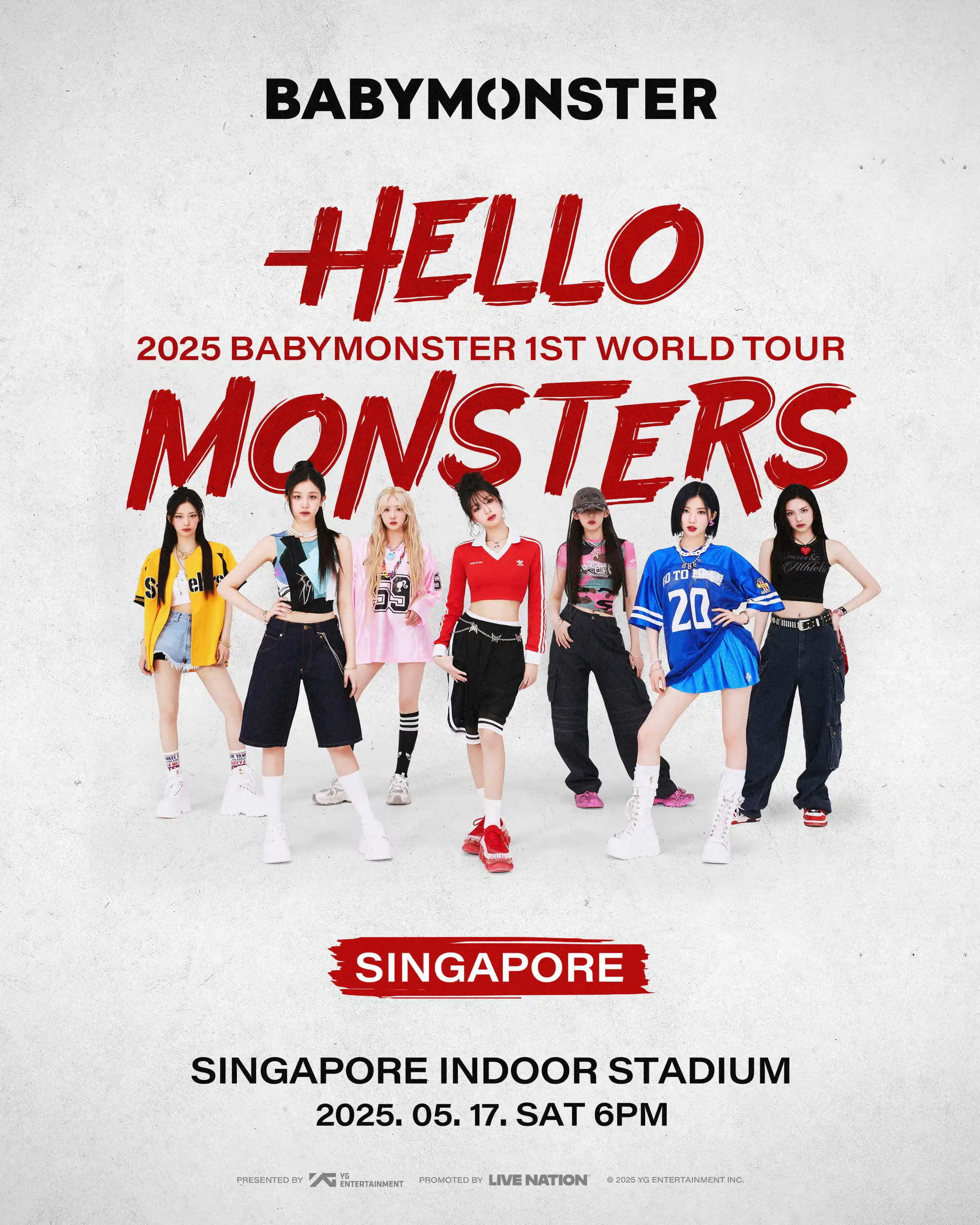
I bought the ticket without telling a single person. My very first time going to a K-pop concert.
No "should I go?" messages, no "see you there!!" comments, nothing. Just me, my laptop, the BABYMONSTER tour page, and a very impulsive click on "Confirm payment." The Singapore date was locked in, and suddenly this thing that had only existed in announcements and timelines turned into my actual plan.
I wish I could say I handled it calmly. In reality, I stared at the confirmation email for a good minute, grinning at the screen like an idiot.
Knowing it would be six, not seven
By the time the concert rolled around, the situation with Rami was already clear.
The notice explained that she would be sitting out the Singapore show (and the rest of that leg) for health reasons, and that the tour would go on with six members while she rested. It was one of those updates that hits twice: disappointment first, then a quieter relief that her wellbeing was being taken seriously.
On a personal level, that stung a bit. Rami's vocals are a huge part of what made me fall in love with BABYMONSTER in the first place. But it also felt completely right that she wasn't being pushed through a full tour.
So I walked toward the venue already knowing the stage would feel different. Six on stage, but always seven in the back of my mind.
Walking up to the stadium
The Singapore Indoor Stadium has its own atmosphere on concert days. Even before the building comes fully into view, the mood gives everything away.
Crowds move in the same direction. Staff in bright vests try to impose some sort of order. Snatches of lyrics float through the air from random phone speakers. That evening, everything screamed BABYMONSTER: tour shirts, banners, lightsticks, tote bags with carefully printed logos.
The weather was its usual humid, clingy self. My hair was already starting to lose the battle, but the excitement easily drowned that out. I joined the slow-moving river of people moving toward the entrance and listened to little pieces of conversation drift past:
"Do you think they'll do a special stage?"
"I'm here mostly for the solos."
"I can't believe this is actually happening."
Everywhere I looked, Rami's name appeared. OT7 badges. "Get well soon" slogans. Banners with her name in bright colours. She wasn't there physically, but fans clearly brought her along in spirit.
My own excitement stayed quiet on the outside, but inside it felt like my heart was already halfway to the arena.
Finding my seat and that pre-show glow
Once my ticket scanned and I stepped inside, everything suddenly became real.
The blast of air-conditioning hit first, then the layered sound of thousands of voices echoing off the walls. I followed the signs, climbed the stairs to my section, and finally saw the full stage.
It looked incredible: a huge central screen, an extended runway pushing into the crowd, side screens looping visuals and the tour branding. The "HELLO MONSTERS" logo flashed in different styles, and the pre-show playlist cycled through BABYMONSTER songs and other familiar tracks.
I sat down, took the obligatory slightly blurry photo of the stage, and then just sat still for a moment.
Around my seat, fans were testing lightsticks, doing last-minute touch-ups on their makeup, recording mini arena tours for social media, or just soaking everything in with dazed smiles. Any time one of the group's songs came on in the pre-show mix, the volume in the arena jumped—voices singing along, claps on the beat, occasional squeals at specific lines.
For a few minutes, I put my phone away completely and just listened. There's something strangely calming about sitting alone in a huge crowd that's excited about the exact same thing.
Lights off. Monsters on.
The moment the main arena lights cut out, the sound level jumped from loud to deafening.
The opening VCR began: glitchy graphics, stylised shots of the members, flashes of lyrics and cityscapes, all building toward the tour title. And then, right when the tension reached its peak, the intro dropped into "DRIP."
The six members appeared, and my brain needed half a second to catch up. That familiar opening suddenly wasn't on a phone screen anymore. The bass shook through the floor; the choreo looked so sharp and decisive that it almost didn't feel real.
From where I sat, tiny details stood out that never fully show up in fancams: subtle expression changes, the rise and fall of their shoulders with each breath, the way they made eye contact with different sections of the stadium.
The opening block hit hard, one song slamming into the next:
"DRIP"
"BATTER UP"
"CLIK CLAK"
"LIKE THAT"
"SHEESH"
There was barely any space to breathe between tracks. It felt like a statement: you waited for this; here is everything at once.
Even with six members, the stage didn't feel empty. The lines and formations had clearly been rebalanced, but nothing looked like a patchwork fix. Everything flowed. Ruka and Asa naturally fell into even more commanding positions at points, and Ahyeon's vocals wrapped around sections so tightly that any potential gap felt covered before it even appeared.
The solo stages and all the feelings
The mood shifted when the concert moved into the solo stages.
Each member's stage felt like a tiny personal universe—a mix of their taste, style, and personality.
Rora's vocal stage turned the arena strangely quiet. Her tone live was clear and bright, and the way she moved between soft and powerful parts made the high notes hit even harder.
Pharita's solo felt like an emotional conversation set to music. At first, nerves showed in the way she held her mic, but the response from the crowd gradually relaxed her expression.
Asa's rap stage was pure chaos in the best possible way—fast, clean, overflowing with attitude. The beat, the flow, the swag… everything was there.
Ruka came out like a storm. Heavy beats, confident gestures, the kind of stage presence that forces every eye to stay locked on her.
Asa & Ruka together felt like a mini unit show dropped into the middle of the concert—energy ping-ponging between them, feeding off each other.
Chiquita's solo was almost jarring in its emotional weight. Her age says "maknae," but the way she delivered the song sounded like someone who had lived through everything she was singing about.
Ahyeon's stage made time blur. Vocals that strong and that stable, live, almost felt unfair. High notes landed cleanly, and even the softer lines carried a kind of intensity that made it hard to blink.
Somewhere in the middle of all that, my throat started reminding me how much I had already shouted, but there was no way anything was going to stay quiet at that point.
Six people, seven spaces
Strangely, the moment that lingered the most from the entire night wasn't a song—it was a talk segment.
After the solos, the members gathered to chat with the audience. They switched between Korean and English, slipped in a few practiced phrases in the local language, and laughed about the heat, the food, and how loud Singapore fans were.
Then the conversation turned to Rami.
They didn't pretend nothing was different. They openly said they missed her, acknowledged that fans did too, and asked everyone to keep supporting her while she rested and focused on getting better.
The mood in the stadium softened instantly. OT7 banners lifted higher, "get well soon" messages popped up all around, and for a few seconds the noise felt less like screaming and more like warmth.
They also mentioned wanting to show performances that would make her proud when she comes back.
That line clung to the back of my mind for the rest of the concert.
After that, every part where her voice would normally cut through felt charged in a different way. Instead of standing out as a gap, those moments felt like invisible threads stitched into the performance—still present, just not visible.
Ballads, phone lights, and a lump in the throat
The emotional peak—for me, at least—came during the ballad section.
Slower songs always shift the atmosphere, and this was no exception. The jumping and shouting faded into swaying and singing, the arena swapping raw noise for something a little more fragile.
At one point, the members asked everyone to switch on phone flashlights.
Normally, that can feel a bit cliché. But standing there in that moment, looking around at a stadium quietly flooded with tiny white lights, everything clicked into place. Their voices poured over that sea of light, and the wide shots on the screen turned the whole arena into one moving, glowing backdrop.
There was one simple frame: the six of them standing in a line, silhouettes against the glow of thousands of points of light. It's the kind of image that sinks in and quietly refuses to leave later.
That was the moment a lump settled in my throat and stayed there.
Party mode: restored
Once the emotional damage was done, the group yanked the energy back upwards.
Brighter, more playful songs took over. The stadium shifted from swaying back into full-body movement. Fans jumped, shouted, danced in place; lightsticks flew in wild patterns; and occasional off-beat claps added their own charm to the chaos.
The members sprinted up and down the runway, waved at every corner, posed for the cameras, and messed around with the angles on the big screens. There was also a medley of familiar hits that sent the noise level soaring again—a little nod to their roots and the music world they stepped into.
The main set ended on a perfect mix of hype and sentiment. One moment the crowd was yelling like it was the last night on earth; the next, voices softened into slightly hoarse singing along with more emotional lines.
Then the stage went dark. The members vanished. The encore chant began almost immediately, as if everyone had silently agreed not to give their lungs a break.
Encore: dragging out the goodbye
The encore felt less like a structured block and more like a shared cooldown.
When the members came back out, outfits looked more relaxed, hair a little less stiff, mood far more playful. Remixed versions of the title tracks turned the whole stadium into something that felt halfway between a concert and a club night.
They ran around the stage, waved at cameras, pulled faces on the big screen, and stretched every last moment as far as possible. During the final song, they didn't even try to sing every part themselves. Microphones pointed to the crowd, and the fans gladly took over.
Sometimes, they just stood still and looked around, eyes moving slowly across the stands like they were trying to capture every single lightstick and every single face.
Confetti rained down. Hands linked. A deep bow, the kind that feels like a full stop at the end of a long paragraph. One last round of waves, hearts, and blown kisses.
Then the house lights came back on for good.
This time, the end felt real.
Stepping back into normal life
Walking out of the stadium felt like stepping out of a dream and straight into humid night air.
Fans immediately snapped back into debrief mode: trading favourite moments, arguing playfully over which solo had the most impact, comparing fancams, checking how much storage their phones had left, planning late-night food.
Some people took photos with their Rami banners, almost like sending her one last invisible message.
I moved slowly through all of that noise, replaying random fragments in my head: the very first hit of "DRIP," Asa's rapid-fire rap, Ruka's power, Chiquita's unexpectedly heavy emotion, the mention of Rami, the ocean of phone lights during the ballad, the last bow under falling confetti.
On the train home, I finally opened my gallery and scrolled. Half the videos were shaky. Zoomed-in shots weren't nearly as crisp as they had felt in the moment. But that didn't matter. None of it was supposed to replace the feeling of being there anyway.
The imperfections almost made the memories feel more real.
What stayed behind after the sound faded
If the whole night had to be reduced to a single idea, it would be this:
Six people stood on stage and did everything possible to hold space for seven—and somehow, the one who wasn't there still felt present everywhere.
BABYMONSTER didn't come across as rookies tentatively testing the waters. The performances felt like the beginning of something big, carried by a group that is already capable of owning an arena while still looking genuinely overwhelmed that so many people showed up.
I went in alone, quietly, without telling anyone I was going. No pre-show bragging, no "I'm here!!" posts.
I walked out with aching legs, a trashed voice, hair that had absolutely lost the battle with the weather—and a heart that felt strangely calm and full at the same time.
Somewhere out there, I hope Rami eventually sees how loudly fans supported her even in her absence. In that stadium, her name and her voice lived in every banner, every line that fans filled in for her, every lightstick lifted a little higher during the mention of her rest.
When I finally got home, I dropped my bag, kicked off my shoes, opened a blank page, and started typing all of this out.
The whole thing began as a secret plan. But some experiences are simply too big to keep entirely to myself.